Eddie Mars
The Big SleepEddie Mars is a casino proprietor and criminal power broker whose apparent civility masks a network of gambling, protection, blackmail, and violence. He owns Arthur Geiger’s house, claims to know the business conducted around him, and ultimately uses the disappearance of Rusty Regan to obscure a larger scheme. Through Mars, the novel links apparently separate crimes to the profitable management of risk, information, and official appearances.
Identity and Public Face
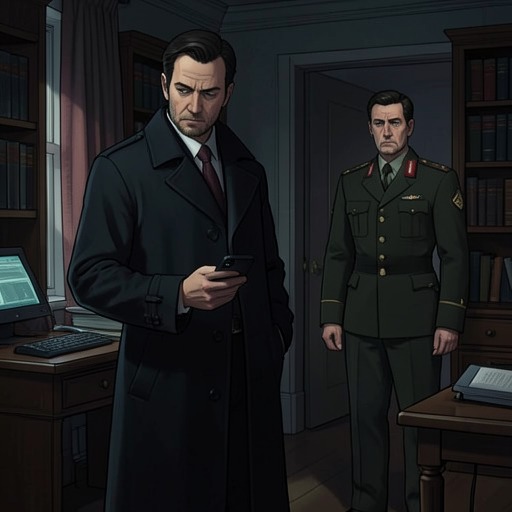
Mars first appears at Geiger’s house as a carefully composed, affluent man: dressed in gray, with polished black shoes and red diamond motifs on his tie. His manner is courteous, his smile easy, and his movements controlled. The description distinguishes his hardness from the recognizable posture of a street tough; Mars looks instead like a weathered horseman, though he is not one. The cultivated exterior is part of his influence: he enters without being announced, notices Carmen Sternwood, and asks for Geiger as if the visit were ordinary business.
When Marlowe challenges him, Mars reveals that Geiger is his tenant and that he owns the house. He does not initially offer a clear account of Geiger’s activities. Instead, he suggests that Marlowe’s business could become his own, testing whether the detective will disclose what he knows. Mars’s control of the property gives him a direct connection to Geiger, while his measured talk lets him present that connection as routine rather than incriminating.
Gambling and Protection
Marlowe associates Mars with the Cypress Club at Las Olindas, where gambling caters to wealthy patrons. He also describes Mars as having local law enforcement in his pocket and a well-established line into Los Angeles: protection that could be useful to a criminal operation such as Geiger’s illicit book-lending business. Mars reacts sharply when Marlowe names that racket, denying knowledge of it rather than accepting the detective’s account of his involvement.
The club’s business is only one part of Mars’s position. His reach rests on relationships that can shelter illicit activity and make investigation difficult. Marlowe’s inference is that Geiger benefited from protection because the book business required it; Mars’s ownership of Geiger’s house makes the connection tangible even before the full scheme is explained. The novel thus presents protection not as a separate service from criminal enterprise, but as infrastructure that lets profitable rackets continue.
Mars also displays the respectable face of security. At his home, he points out a vault and jokes that he would be vulnerable to a robbery gang except for that safeguard. He says local police officers come by each morning to watch him open it, under an arrangement with them. The scene makes police attention part of his everyday presentation: the vault appears protected, and the officers’ visits imply public oversight, even as Marlowe has already described Mars’s influence over local law enforcement.
Geiger’s Racket and Mars’s Method
Marlowe’s estimate of Geiger’s operation shows the potential value of the illicit book stock Mars is linked to. Geiger’s coded customer list contains about five hundred names; Marlowe knows of twelve boxes of books and estimates a total stock of roughly five hundred volumes. If half the list rented books, and each rental brought at least a dollar, the business could generate about $125,000 in rentals while retaining the value of its inventory. These figures are Marlowe’s cautious calculation, not a verified accounting, but they explain why the racket and its protection mattered.
Marlowe initially suspects that Geiger’s attempt to blackmail General Guy Sternwood may have been connected to Mars. Mars counters that Geiger worked the scheme on his own. According to Mars, Geiger obtained promissory notes that appeared legally enforceable, presented them to see whether their holders were frightened, and pursued blackmail only when he sensed that a target might pay. If a target did not respond, Geiger abandoned the attempt. Mars’s explanation casts Geiger as a flexible operator who tested the value of compromising information rather than pursuing every target alike.
That account does not clear Mars of involvement. In Marlowe’s final reconstruction, Mars stood behind Geiger, protected him, and used him as a cat’s-paw. Geiger’s particular blackmail attempt could have been his own idea while still serving the interests of a larger operation. Mars’s method is therefore less a matter of directing every move than of placing intermediaries between himself and the crimes from which he might profit.
Regan, Mona, and the Cover Story
Mars’s connection to Rusty Regan emerges gradually. When he contacts Marlowe, he recognizes that the detective is being associated with the search for Regan and invites him to visit at the beach, offering the possibility of information. The overture keeps Mars at the center of the investigation while allowing him to appear helpful. His knowledge, and his choice of when to disclose or withhold it, become part of the case’s pressure.
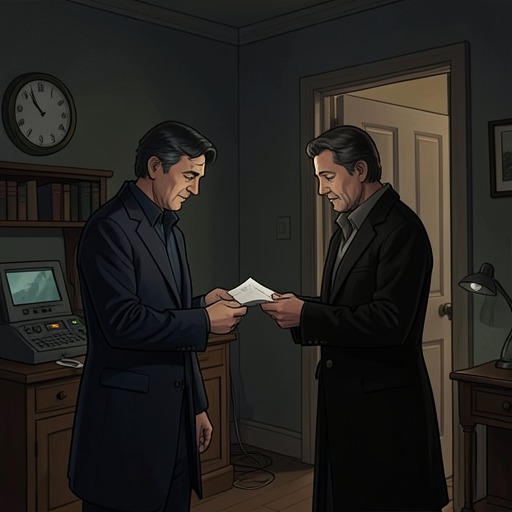
Harry Jones later describes Lash Canino as a man Mars employs when he needs trouble handled. Jones reports that Joe Brody followed Canino to the Sternwood estate, where Vivian Regan met him and appeared to pass him something, perhaps money. Jones suspects that Canino may have known something about Regan and tried to profit from it, but explicitly treats this as uncertain. His account establishes Mars’s use of Canino as a troubleshooter and places Vivian in contact with Canino; it does not by itself prove what was exchanged or why.
Marlowe’s eventual explanation gives those fragments their larger context. He says Mars hid Mona Mars at Realito and put Canino on guard, encouraging the belief that Mona had run away with Regan. Mars also arranged for Regan’s car to be placed in the garage where Mona had been living. The staged evidence turned Mona’s concealment into an apparent elopement and offered a convenient explanation for Regan’s disappearance. Marlowe argues that Mars was not merely diverting suspicion from himself: he wanted the police to accept a story that would keep them from discovering where Regan had gone and why, protecting a much larger potential profit.
Exposure and Narrative Significance
Marlowe’s account to Vivian brings Mars’s separate connections together: Geiger’s blackmail, Brody’s possession of photographs, the gambling tables, Canino’s violence, and the false story about Regan and Mona. The explanation identifies Mars as an organizer who makes other people’s crimes and vulnerabilities useful to him. Geiger supplies a means of blackmail; Canino supplies force; the planted car and Mona’s concealment supply a misleading narrative. Mars’s power lies in arranging these pieces so that a profitable operation can survive behind a plausible public account.
That account is itself surrounded by compromised official narratives. In the newspaper version of the earlier murders, Captain Cronjager receives credit for solving the cases, while the reported sequence and motives conceal the involvement of the Sternwoods, Marlowe, and the real circumstances of the deaths. Mars’s schemes belong to this wider atmosphere of protection and concealment, though the newspaper account does not directly name him. His role helps explain why apparent explanations in the novel cannot be treated as reliable simply because they are repeated by police or printed in the press.
Mars’s final significance is structural as well as criminal: he links the book’s competing economies of illicit rentals, blackmail, gambling, and hired violence, while exploiting the distance between what happened and what authorities can be made to believe. Marlowe can expose that design to Vivian, but the revelation does not undo the harm or restore a clean distinction between lawful order and criminal protection. Mars’s influence is measured by how effectively his intermediaries and cover stories keep the truth out of view.